Nations Championship first leg concludes with mixed results and officiating concerns


Inaugural Nations Championship sees strong performances amid ongoing issues
The initial phase of the inaugural Nations Championship has concluded, showcasing compelling rugby action alongside persistent officiating challenges. While the new format has garnered positive feedback from viewers, the sport continues to grapple with inconsistencies in refereeing and the application of Television Match Official (TMO) decisions.
Several teams delivered notable performances. South Africa demonstrated dominance, particularly in their match against Wales, and along with France, they lead their respective hemisphere tables. New Zealand also impressed, reminding observers of their offensive capabilities and securing maximum points from their fixtures. The All Blacks‘ new head coach, Dave Rennie, has guided the team to three victories from three matches.
Individual players also stood out. France scrum-half Maxime Lucu leads the points scorers with 37 points, including a brace of tries against Japan. Will Jordan of New Zealand is the top try scorer with six tries, setting a new record for the All Blacks in terms of total Test tries with 51. Italy‘s Ross Vintcent recorded the most tackles, while Matthieu Jalibert of France made the most metres, with 268 metres. Argentina‘s Joaquín Oviedo led in carries with 60, and Jack van Poortvliet of England registered four assists.
Officiating and rule interpretation spark debate
Despite the excitement generated by the matches, the tournament has highlighted rugby’s ongoing struggle with its own rules and their enforcement. Incidents such as a ruck clear-out by New Zealand‘s Luke Jacobson, which resulted in only a yellow card despite appearing to warrant a red, and uncalled deliberate knock-ons, have drawn criticism. These decisions are particularly impactful given the narrow margins in top-level rugby.
A significant point of contention arose during Argentina‘s defeat to England, where a potential try for Argentina was disallowed after an extended TMO review. The prolonged review process, which involved multiple slow-motion angles, ultimately led to questions about the decision and extended the game’s duration significantly. This incident, among others, has prompted suggestions for streamlining TMO interventions, proposing they be limited to head injuries or serious foul play, with other decisions remaining with the on-field referee.
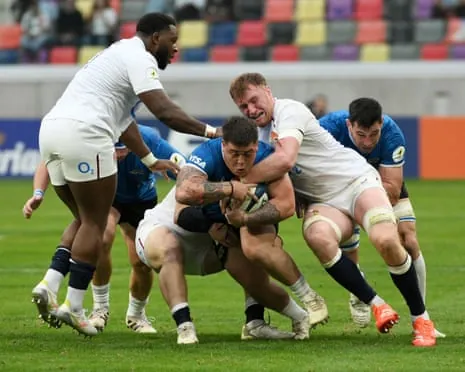
Further proposals for rule adjustments include modifying penalties for less serious one-handed knock-ons, suggesting a scrum or tap penalty 20 metres upfield instead of a yellow card. It has also been suggested that only team captains should be permitted to communicate with referees, and that players instigating head contact should receive a 20-minute orange card to clarify red or yellow card decisions.
Attendance figures and future considerations
The opening leg of the Nations Championship saw a total attendance of 641,550 across 18 matches, averaging 35,642 spectators per game. The highest attendance was recorded at Scottish Gas Murrayfield for the match between Fiji and Scotland, with 55,125 attendees, marking a new national record for Fiji.
However, some matches experienced lower attendance, such as Japan versus Ireland in Newcastle, Australia, which drew 11,021 spectators, filling only a third of the stadium’s capacity. The logistical demands of the new tournament have also been noted, with players like England‘s Ben Earl confirming the travel challenges.
The competition’s format means the two current unbeaten sides, both from the same hemisphere, are unable to meet in the final. The impact on ticket sales for future matches, especially if teams are out of title contention, remains a consideration for the upcoming November fixtures.

The Southern Hemisphere teams collectively scored 36 more points and five more tries than their Northern Hemisphere counterparts over the 18-game summer series, with both hemispheres winning 50% of their matches.
Read Also
Source: theguardian.com

